VMEX
VMEX is a clean-room, JAX-native reimplementation of the VMEC2000
ideal-MHD equilibrium code for stellarators and tokamaks. It solves fixed- and
free-boundary equilibria with VMEC2000-parity numerics, writes standard
wout_*.nc output, and — unlike the Fortran original — is differentiable
(fixed boundary by implicit differentiation, free boundary through the
virtual-casing vacuum field) and runs on CPUs and GPUs.
Why VMEX?
VMEC2000 parity. The solver ports the VMEC2000 algorithms (steepest-descent moment method, 1D radial preconditioner, Richardson time stepping, spectral condensation, NESTOR vacuum solve) constant-for-constant. Benchmark decks converge in the same iteration counts as VMEC2000 and the
woutfiles agree per-variable (see Performance and validation). An optional 2D block preconditioner cuts iterations 2.5–11x on stiff decks while leaving the default path byte-identical.Differentiable. Gradients of fixed-boundary equilibrium properties with respect to boundary shape and profile parameters via implicit differentiation of the converged fixed point (
vmex.core.implicit) — no finite differences, no iteration unrolling — validated against central finite differences (see Optimization and differentiability), with an O(1)-memory adjoint. Free-boundary equilibria are differentiable end-to-end through the virtual-casing vacuum field (coil /extcurderivatives), finite-difference-validated (vmex.core.freeboundary_diff). A growing objectives library — quasisymmetry, omnigenity, Redl bootstrap, ballooning stability, gyrokinetic turbulence proxies — plugs straight into a least-squares driver with those exact gradients, reaching precise QA in a single 14.5-minute CPU call (Optimization and differentiability).Drop-in workflow. The
vmeccommand reads VMEC2000input.*namelists and VMEC++-style JSON, prints VMEC2000-format iteration output, and writeswout_*.ncfiles that load unchanged in simsopt and booz_xform.Batteries included. Built-in plotting (
vmex --plot), Boozer transform (vmex --boozviabooz_xform_jax), spline profiles, multigrid with hot restart, free boundary from mgrid files or directly from coils, and typed zero-crash error handling. The shared linear/adjoint solver layer is factored out into SOLVAX.
Quickstart
pip install vmex
vmex --test                       # bundled QH case: solve + wout + plots
vmex input.circular_tokamak       # run any VMEC input deck
vmex --plot wout_circular_tokamak.nc
See Quickstart for a full tour, including the Python API and the Boozer-coordinate workflow.
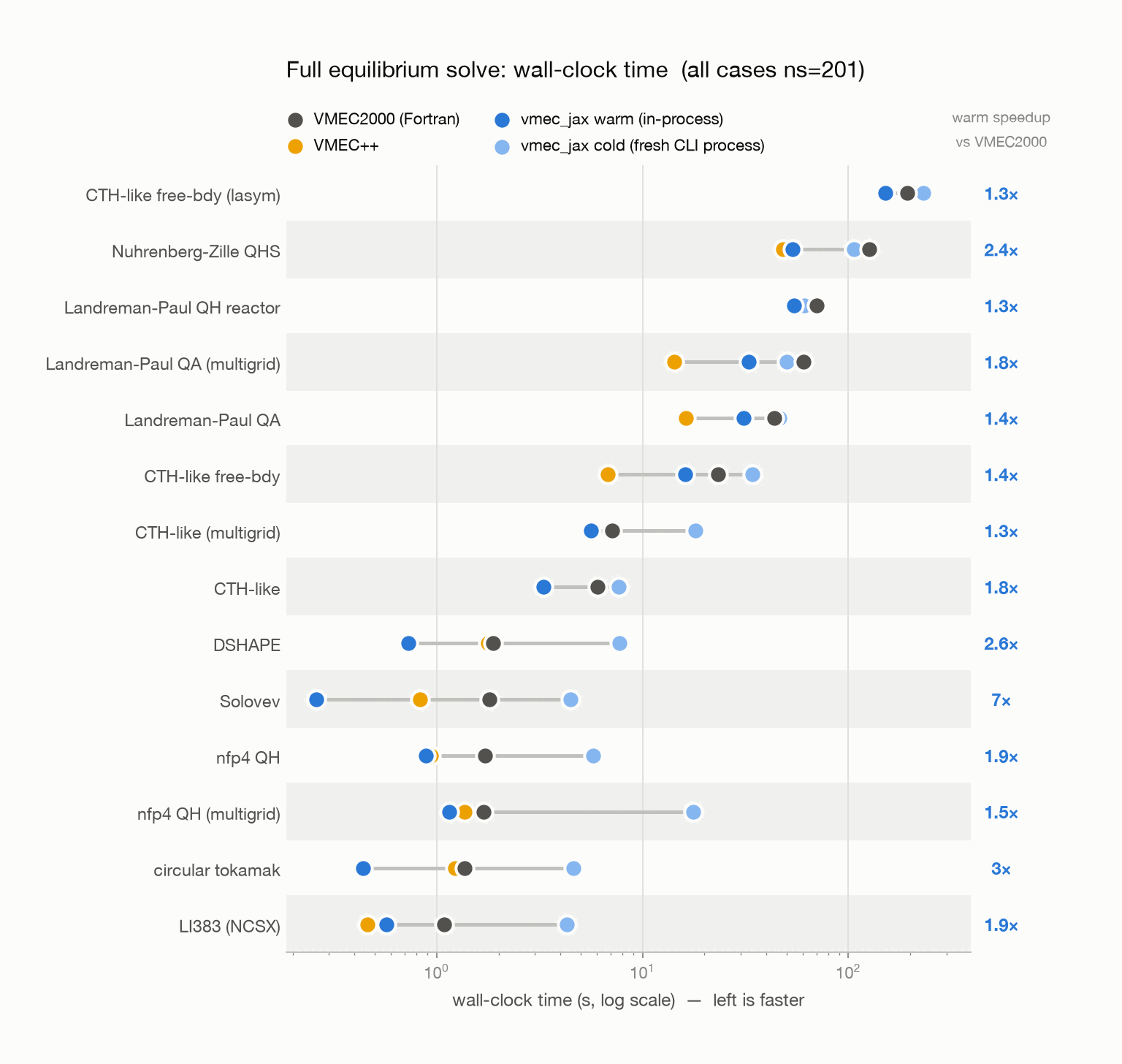
Benchmark-suite runtimes: vmex (cold and warm) versus VMEC2000 and
VMEC++. Warm (compiled-cache) solves are the relevant number for
optimization loops; see Performance and validation for the full table.
Documentation
Getting started
Tutorials
Theory and numerics
Performance and validation
Developer guide